
Most safety leaders filed AI under "IT will deal with it later". They couldn't be more wrong. AI has become a new category of workplace safety risk.
👋 Hello, Lucas Domingues here and welcome to the 7th edition of Safety 4.0 Insights in 2026. As AI in EHS content floods the internet, true signal is becoming rare. This newsletter is where we keep it real: human, SafetyTech clarity, and practical AI for EHS leaders. Thanks for helping make it a leading publication.
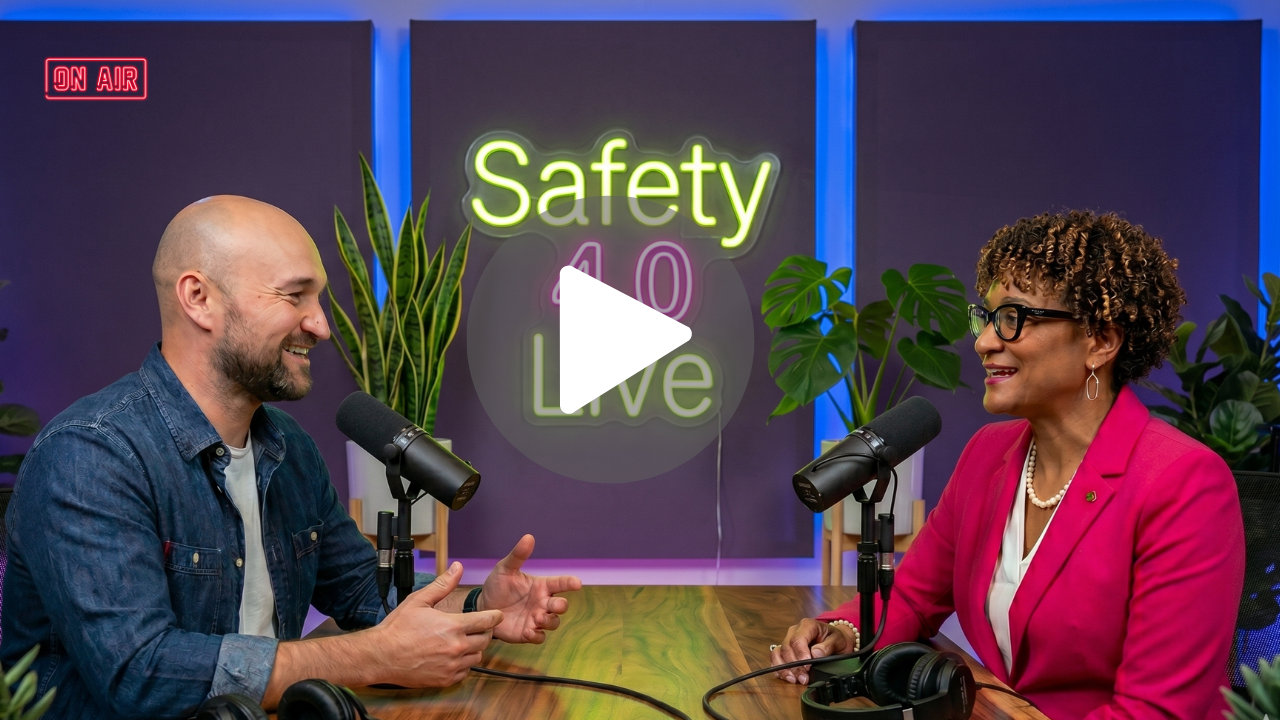
Earlier this week, it was a pleasure to collaborate with the American Society of Safety Professionals (ASSP) and host Stephanie L. Johnson, CSP, CHMM for a chat about the evolving role of safety professionals in the digital age, ASSP's AI task force and white paper.
📺 Watch the episode here.
🎓 Now is a great time to learn and upskill in AI, safetytech and digital transformation. Here's how the Safety 4.0 Academy can help you:
Join the waitlist of Safety 4.0 Accelerator cohort in September (IOSH approved and CPD certified). A global 6-week on-line interative programme designed by and for senior EHS & Risk Leaders navigating the AI transition [special discount for groups or in company].
Let's go 🚀
Here's the headline that went round in June: the European Parliament voted to push the big AI rules back to 2027 and 2028. A lot of EHS leaders read that, thought "not my problem this year," and moved on.
That's the trap. One rule wasn't delayed and it's the one that lands on your desk first. It's called Article 4 - AI Literacy, and it says something simple: if your people use AI, you have to make sure they actually understand it. It's been law since February 2025, and authorities will enforce it.
But first, what is literacy? It is "the ability to read, write, speak, and listen effectively".
💡 So in the context of AI, it is a skill to understand AI and develop basic fluency on it to understand how it works, including benefits and potential risks.
What Article 4 actually says?
In short, AI providers and deployers must take measures to ensure, to their best extent, a sufficient level of AI literacy among staff and others operating AI on their behalf, taking into account those people's technical knowledge, experience, education and training, the context the systems are used in, and the persons or groups on whom the systems are used.
Does this apply EHS teams? Almost certainly yes!
You don't have to build AI for this to apply. You just have to use it. And your team almost certainly already does:
Someone's using Microsoft Copilot to draft a procedure, risk assessment or summarise an incident report. Your EHS software now has an AI assistant that you can chat with. Maybe someone on your team pasted a near-miss report into ChatGPT to "tidy it up."
Every one of those triggers Article 4. It doesn't matter that you only bought a subscription. The law calls you a "deployer," and the duty is yours.
"But there's no fine for it". Be careful!
Here's where people relax for the wrong reason. Article 4 has no fine attached to it directly. So it's tempting to file it under "low priority." Don't.
A literacy gap rarely gets you in trouble on its own, it gets you in trouble when something else goes wrong. An AI tool feeds something poorly, an incident follows, and the investigation asks: did the people using this tool actually understand it? If the answer is no, that gap turns an honest mistake into a negligence finding.
You already know this logic. It's exactly how a competence gap works in any other safety system. The finding is never "you skipped the training", it's "someone got hurt, and you couldn't show your people were competent to prevent it."
Article 4 is just competence management, pointed at AI.
So how much understanding is "enough"?
The law won't give you a single number, and that frustrates people. But it does give you a rule of thumb you already use every day: the higher the stakes, the higher the bar.
Someone using AI to tidy up the wording of a memo needs to know the basics, what it's good at, where it makes things up, when to double-check. Someone using AI to decide which site gets inspected first needs to understand far more, how the tool can be wrong, and when to overrule it. It's likelihood and severity, applied to AI. Nothing new.
The four-step framework
Here's how to get compliant without it becoming a project that eats your year.
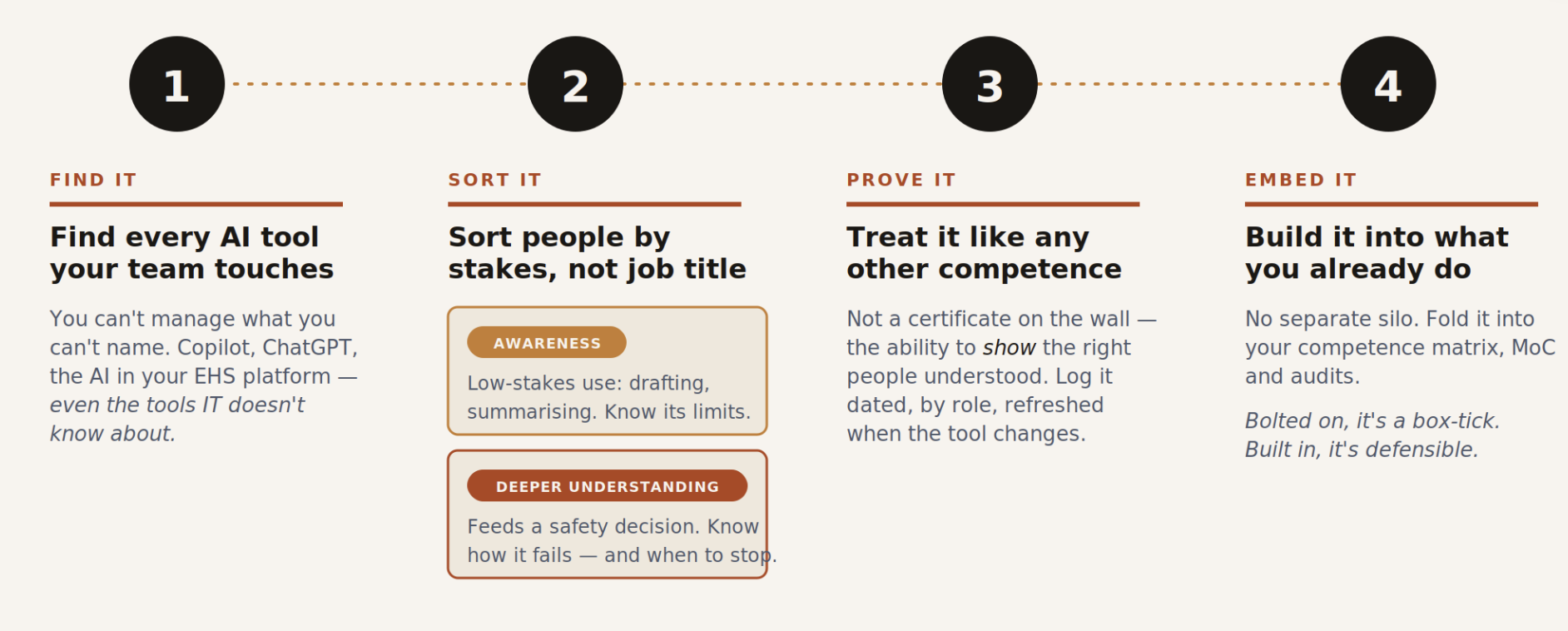
4-step framework to map AI tools / comptency in EHS
This week: list every AI tool your team uses on one page. Mark each as "awareness" or "deeper understanding." Add one line "AI literacy" to your competence matrix. That single page is the difference between "we've got this handled" and "we hoped nobody would ask."
The deadline that wasn't delayed is the one most safety teams haven't started.
Start it before August, and Article 4 stops being a compliance threat and becomes what it should be: proof your team understands the tools it now relies on.
👉 One question to sit with: if an inspector asked tomorrow, could you show your team understands the AI they're already using?
Thanks for reading it.
Lucas
References
- Regulation (EU) 2024/1689 (EU AI Act), Article 4 — AI Literacy (operative text). euaiact.com/article/4
- Regulation (EU) 2024/1689, Article 3(56) — definition of "AI literacy".
- Regulation (EU) 2024/1689, Article 99 — Penalties (no standalone Article 4 fine category). ai-act-service-desk.ec.europa.eu
- European Commission, AI Office — Article 4 AI Literacy Q&A (May 2025) and the Living Repository of AI Literacy Practices.
- Digital Omnibus on AI — European Parliament final approval, 16 June 2026 (Council adoption expected late June); defers high-risk obligations only (Annex III to 2 Dec 2027; Annex I to 2 Aug 2028). Analyses: Gibson Dunn; Pinsent Masons; White & Case.
- Regulation (EU) 2024/1689, Article 113 — entry into force and application dates; national enforcement from 2 August 2026.
Transparency note: AI (Claude Opus 4.8) was used whilst curating parts of this edition. All opinions are my own. This newsletter is editorial commentary for EHS practitioners and is not legal advice; for compliance decisions, consult qualified counsel in your jurisdiction.


Responses